Why Won't My Jet Ski Start? Common Causes and How to Fix Them
Share
Few things kill a day on the water faster than turning the key and getting nothing. The good news: almost every no-start on a jet ski comes down to a short list of usual suspects. Here is how to track it down on a Sea-Doo, Yamaha, or Kawasaki, in the order worth checking.
First: no crank, or cranks but won't fire?
Before you touch anything, establish which problem you actually have. These two symptoms point in completely different directions, and skipping this step is how people end up replacing parts they didn't need.
- No crank — you press start and hear nothing, or just a click. The engine isn't even trying to turn over. That's a battery or electrical problem. Work through causes 1–4 below.
- Cranks but won't fire — the engine turns over but never catches. That's fuel, spark, or compression. Skip to causes 5–7.
If yours cranks but won't catch, our Sea-Doo cranks but won't start guide goes deeper on that specific case. If you're hearing a rapid click, see jet ski just clicks when you start it.
1. Dead or weak battery (the #1 cause)
This is by far the most common reason a jet ski won't start, especially the first ride of the season. If the starter cranks slowly, just clicks, or does nothing at all, check the battery first.
A healthy 12V battery reads 12.6–12.8V at rest. Below 12.4V is a warning zone; below 12.0V it's effectively dead. Resting voltage only tells half the story though — a battery that reads 12.7V at rest can collapse to 9V the moment a starter draws current. A load test is the only reliable confirmation, and most auto parts stores will do one free.
PWC batteries hate sitting. One winter without a tender is often enough to finish one off. If it won't hold a charge, replace it. You can find batteries and electrical parts in our Electrical section.
If yours keeps going flat even after replacement, the charging system is the real problem — see Sea-Doo battery keeps dying or won't charge.
2. Corroded or loose battery connections
Terminals on a PWC take a beating from salt, humidity, heat cycles, and vibration. A thin layer of white or greenish oxidation on the posts creates enough resistance to starve the starter — and a terminal that looks seated but isn't fully tight does exactly the same thing.
Disconnect the negative first, clean both posts and cable ends with a wire brush and a baking soda and water solution, then reconnect firmly with the negative last. This step alone solves a surprising number of no-starts, and it costs nothing.
3. Blown fuse or starter relay
Check the main fuse — a blown one will kill power to the starter circuit or fuel system entirely. Find the fuse box (usually under the front or rear access hatch near the battery) and inspect each fuse visually or with a multimeter.
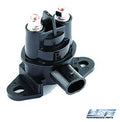
A single loud click with no crank usually points to a weak battery or a failing starter relay/solenoid. The solenoid is a wear item: on machines that sat with a dead battery connected, the internal contacts burn or corrode. On most models it's a $20–$50 part and a 30-minute job. Solenoids and starters are in Starter Solenoids and Starters.
4. The safety lanyard or key
Sea-Doo machines use a DESS key — if the key is worn or the post is dirty, the ski won't start. Yamaha and Kawasaki use a lanyard cap that has to be seated correctly to complete the circuit. Make sure yours is clean and properly attached. Also confirm the kill switch is in the Run position, and on some older Kawasaki and Yamaha models, that the manual fuel petcock is open.
These take ten seconds to check and account for a genuinely embarrassing number of no-start calls at the ramp.
5. Old or bad fuel
Fuel that sat over the winter goes stale and can gum up the fuel system. Ethanol-blended gasoline absorbs water and begins degrading in as little as 30 days — if you didn't add stabilizer before storage, the gas in your tank may be varnished, phase-separated, or simply dead. Smell it: stale fuel has a sour, lacquer-thinner odor.
Also check the fuel filter. A clogged inline filter restricts flow enough to prevent starting, and it's an inexpensive consumable rather than a lifetime part.
On older carbureted 2-strokes — Kawasaki SX stand-ups, the Yamaha SuperJet, and 2-stroke Sea-Doos — a gummed-up carburetor is a classic no-start. The pilot jet is tiny and clogs easily with varnish. Drain the old fuel, add fresh gas with a stabilizer, and if it still won't run, see our guide on how to clean the carburetor on a 2-stroke jet ski. Filters and carb kits are in Fuel System.
6. Fouled spark plugs
Pull the plugs and look at them. What you find tells you more than whether they simply need replacing:
- Black and sooty — running rich, or oil fouling.
- White or blistered — running lean, or past overheating.
- Wet with raw fuel — the engine is flooded, usually from repeated cranking attempts.
- Worn or corroded electrode — normal wear. Replace them.
Always replace plugs in sets and confirm you're using the correct plug for your engine — a mismatched plug causes hard starting even when it looks fine. Browse plugs and ignition parts in Spark Plugs.
7. Hydrolocked engine (stop cranking)
If the starter spins but the engine won't turn over, or you feel hard resistance trying to rotate it by hand, stop immediately. You may have water in the cylinders. Water doesn't compress, and continuing to crank can bend connecting rods and turn a cheap problem into an engine rebuild.
This typically follows a tip-over where the ski sat inverted, or a failed water separator letting water into the intake. Pull all spark plugs, crank briefly to expel water from the cylinders, and let everything dry completely before reinstalling plugs. If the engine still won't rotate freely by hand, get it evaluated before cranking again.
If yours flipped, read jet ski won't start after flipping before you do anything else.
The spring no-start: four things at once
The most common scenario we hear: a ski that ran perfectly in September won't start in May. Nine times out of ten it's one of these four, and often several together:
- Dead battery — sat all winter without a trickle charger.
- Stale fuel — no stabilizer, gas degraded in the tank and lines.
- Gummed carb or fouled injectors — varnish blocking fuel delivery.
- Corroded connections — winter moisture attacked terminals, grounds, and connector pins.
Handle all four as a proper spring recommissioning — fresh or fully charged battery, fresh fuel with the old drained out, new plugs, and a carb clean or injector service as needed — and most spring no-starts resolve on the spot.
FAQ
Can I jump-start a jet ski like a car? Yes, with care. A portable jump pack is the cleanest method. If you're using a car battery, connect with the car's engine off and don't rev it — voltage spikes from a running alternator can damage your PWC's ECU and electronics.
How do I tell the battery from the starter solenoid? Rapid clicking almost always means a dead battery. A single heavy clunk with no cranking points to a bad solenoid — or a battery that's healthy at rest but collapses under load. Fully charge and load test the battery first; if it passes, move to the solenoid.
Can bad spark plugs stop a jet ski from starting entirely? Yes. Fouled, worn, or incorrectly gapped plugs are a legitimate no-start cause, not just a rough-running one. They're cheap — make them part of annual service.
How do I check for fault codes? Modern Sea-Doo models store codes readable with BRP's BUDS software, and many flash a code sequence on the display. Yamaha has its own system. See our Sea-Doo and Yamaha fault code lookup.
Still stuck?
If you have ruled out all of the above, it may be an ignition or compression issue worth a deeper look. Brand-specific guides: Yamaha won't start and Sea-Doo cranks but won't start.
We stock the batteries, plugs, fuel and ignition parts to get you running again — start in Electrical and Fuel System. Always check your model's service manual for exact specs.