Jet Ski Just Clicks When You Start It: What It Means and How to Fix It
Share
Jet Ski Won't Start and Just Clicks? What It Means and How to Fix It
You hit the start button and instead of the engine firing up, you get a click — or a rapid machine-gun series of clicks — and nothing else. If your jet ski won't start and just clicks, you're not alone. This is one of the most common problems PWC owners run into, and in almost every case it comes down to one of four fixable causes. Here's what that sound is telling you, and how to track it down and fix it yourself.
What That Clicking Sound Is Telling You
When you press the start button, the ignition system sends a small trigger voltage to the starter solenoid — a heavy-duty relay mounted near the battery. The solenoid's job is to close a high-current circuit between the battery and the starter motor. When that circuit closes, the starter spins the engine over.
The clicking you hear means the solenoid is receiving the trigger signal. Something downstream isn't keeping up.
Rapid clicking (tick-tick-tick-tick-tick): Classic dead or weak battery. There's just enough charge to fire the solenoid repeatedly, but nowhere near enough to spin the starter motor. The solenoid chatters as it keeps trying and failing.
Single heavy clunk, then nothing: The solenoid is engaging but can't hold the circuit closed. This points to a solenoid that's failing — or a battery that looks healthy at rest but collapses the moment it's asked to do real work.
Either way, when a jet ski won't start and just clicks, you're dealing with an electrical issue, not a fuel or mechanical one. That's good news. These fixes are usually fast, inexpensive, and squarely in DIY territory.
If your symptom is different — the engine cranks and cranks but never fires, or you get dead silence when you hit the button — start with our full jet ski won't start diagnostic guide, which works through fuel, spark, and lanyard/safety-switch causes alongside the electrical ones.
Why Your Jet Ski Won't Start and Just Clicks: 4 Most Common Causes
1. Dead or Discharged Battery
This is the culprit the vast majority of the time. PWC batteries hate sitting. A battery that went through winter without a tender — or sat for a few weeks between summer rides — can drop below the voltage threshold needed to crank a starter motor. Most starters require the battery to hold 12.4V or higher under load. A battery reading 12.6V on a resting multimeter can still fail the moment it's asked to deliver real amperage.
2. Corroded or Loose Battery Connections
Battery terminals on a PWC take a beating. Salt water, humidity, heat cycles, and constant vibration all accelerate corrosion. A thin layer of white or greenish oxidation on the terminal posts creates enough resistance to starve the starter motor. A terminal that looks seated but isn't fully tight does exactly the same thing.
This is the first thing to physically check before you buy a single part.
3. Failed Starter Solenoid
The starter solenoid — sometimes called the starter relay — is a wear item. On older machines, or on machines that sat with a dead battery still connected, the internal contacts burn or corrode. If you're hearing a single heavy clunk with no cranking, and your battery tests strong, the solenoid is the next suspect. On most Sea-Doo and Yamaha models it's a $20–$50 part and a 30-minute job.
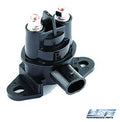
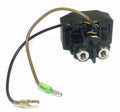
If the solenoid is where you land, browse our PWC starter solenoids to match the right relay to your model.
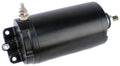
4. Failed Starter Motor
Less common, but it happens. Worn brushes, a dead spot on the commutator, or internal corrosion from water intrusion can all kill a starter motor. If the battery and solenoid both check out, the starter motor is next on the list.
When the starter motor itself is the culprit, our PWC starter motors cover most Sea-Doo, Yamaha, and Kawasaki applications.
How to Diagnose a Jet Ski That Won't Start and Just Clicks
Don't guess. Work through this in order and you'll find the problem in under 20 minutes.
Step 1: Check Resting Battery Voltage
Set your multimeter to DC voltage. With the jet ski off, a healthy, fully charged battery should read 12.6V to 12.8V. Below 12.4V is a warning zone. Below 12.0V and the battery is effectively dead.
If the battery is low, charge it fully with a marine battery charger rated for your battery type — AGM or conventional flooded — then try again before going further.
Step 2: Inspect the Terminals and Cable Ends
Disconnect the negative cable first. Inspect both terminal posts and both cable ends. Any white powder, green fuzz, or surface corrosion? Clean it off with a baking soda-and-water solution and a wire brush. Reconnect firmly — both terminals should have zero movement. Reconnect the negative last.
You'd be surprised how often this step alone solves it.
Step 3: Load Test the Battery
A resting voltage reading only tells half the story. A battery that reads 12.7V at rest can crater to 9V the moment a starter motor draws current. A load test is the only reliable confirmation.
Most auto parts stores will do this for free. A home battery load tester is a worthwhile $30 investment if you work on your own equipment. A healthy battery should hold above 9.6V under a load equal to half its cold cranking amp (CCA) rating.
If it fails the load test, replace it. Spec your replacement to your model's exact CCA and Ah requirements — a marine AGM is the right choice for most PWC applications.
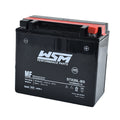
If the battery will not hold a charge, replace it with a proper marine AGM battery built for PWC use rather than an automotive unit.
Step 4: Test the Starter Solenoid
Locate the solenoid — on most Sea-Doos and Yamahas it's a small cylindrical or box-shaped unit mounted near the battery tray. With the battery fully charged and connections clean, use your multimeter to check for 12V at the solenoid's small trigger terminal when you press the start button. If voltage arrives at the trigger input but doesn't appear at the large output terminal, the solenoid has failed.
You can also bridge-test the solenoid by carefully jumping the two large terminals with a screwdriver while the jet ski is in neutral. This bypasses the solenoid entirely and sends current directly to the starter motor. If the engine cranks, the solenoid is confirmed bad.
Step 5: Bench Test the Starter Motor
If the solenoid and battery both pass, pull the starter motor and test it off the machine. Apply 12V directly to the motor's terminals from a charged battery. It should spin immediately, powerfully, and without hesitation. Slow, weak, or no rotation means the motor needs replacement.
Parts You'll Need
Once you've identified the cause, here's what to have on hand:
- Multimeter — non-negotiable for any electrical diagnosis
- Marine battery charger — to fully charge before testing
- Marine AGM battery — sized to your model's CCA and Ah specs
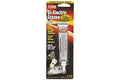
- Terminal cleaning brush and dielectric grease — clean up and protect the connections
- Starter solenoid — model-specific; use OEM or a confirmed direct-fit replacement
- Starter motor — only if the solenoid and battery both pass
A battery swap is a 15-minute job. Solenoid replacement typically runs 30–45 minutes. Even a starter motor pull-and-replace is usually under two hours with basic hand tools.
Stop It from Happening Again
The most common trigger for a jet ski that won't start and just clicks is a battery that wasn't maintained through the off-season or between long stretches without use. A few habits that prevent it:
- Use a battery tender during storage — a quality float charger keeps the battery at full charge without overcharging
- Disconnect the negative terminal if you're not using a tender
- Apply dielectric grease to the terminals every spring to slow corrosion
- Load test every spring before the first ride of the season
A properly maintained marine battery should last 3–5 years. Neglect it through one winter and you might get one.
FAQ
Why does my jet ski click but not start? Clicking on startup almost always points to an electrical issue — a dead or weak battery, corroded battery terminals, or a failing starter solenoid. The click is the solenoid attempting to engage the starter motor. Test battery voltage first with a multimeter, check your connections, and work through the solenoid before assuming the worst.
Can I jump-start a jet ski like a car? Yes, with care. A portable jump pack is the cleanest method — just connect and crank. If you're using a car battery, connect with the car's engine off and do not rev the car while jump-starting. Voltage spikes from a running alternator can damage your PWC's ECU and electronics.
How do I know if it's the battery or the starter solenoid? Rapid clicking almost always means a dead battery. A single heavy clunk with no cranking points to a bad solenoid — or a battery that's healthy at rest but collapses under load. Fully charge and load test the battery first. If it passes, move on to testing the solenoid.
How much does a replacement solenoid cost for a jet ski? Starter solenoids for Sea-Doo, Yamaha, and Kawasaki PWCs typically run $15–$60 depending on model and whether you go OEM or direct-fit aftermarket. It's one of the least expensive electrical fixes and a very common wear item on machines with a few seasons of use.
Get Back on the Water
When your jet ski won't start and just clicks, the fix is almost always within reach — a charged battery, clean terminals, or an inexpensive solenoid. Start with the basics, test methodically, and you won't be down for long.
Everything JetSki stocks the parts you need to get your Sea-Doo, Yamaha, or Kawasaki back in the water: marine batteries, starter solenoids, starter motors, terminal hardware, and more. Browse the full inventory at everythingjetski.com — the right part for your model, no dealer markups, shipped fast.