Sea-Doo Battery Keeps Dying or Won't Charge? Charging System Diagnosis (4-TEC + 2-Stroke)
Share
Your Sea-Doo battery keeps going dead, the ski dies after a while on the water, or you're seeing a "12V" warning on the gauge. Before you throw a battery and a regulator at it, read this. Most "charging" complaints are one of three things: a battery that was never actually dead-from-charging, a bad connection, or a failed regulator/rectifier. A true stator failure is rare. Here's how to tell them apart in about five minutes with a $20 meter.
First, the one thing nobody tells you
A Sea-Doo's charging system only maintains the battery - it does not recharge a dead one. The stator puts out a small maintenance charge, enough to top off a healthy battery while you ride. It is not an automotive alternator. So if your battery went flat sitting in the garage all winter (or from a slow drain), running the ski will not bring it back. You have to charge it on a proper smart charger first. A huge number of "it won't charge!" calls are really "the battery was too far gone and riding couldn't save it."
That single fact rules out a lot of unnecessary parts buying. Start there.
Scope - which skis this covers
This applies to Sea-Doo personal watercraft with a 12V battery and gauge, both eras:
- 4-TEC (fuel-injected, 2002 and newer) - GTI, GTX, RXP, RXT, Wake, GTR, Fish Pro, Explorer, etc. These have a smart gauge that throws "12V low / 12V high" and fault codes.
- 2-stroke (carbureted, RFI, and DI, roughly 1990-2007) - SP, GTS, GTX, XP, GSX, 580 through 951. Simpler system, separate stator and rectifier.
Important: The charging part is the electrical stator coil / armature - the winding on the magneto that makes the electricity. Do not confuse it with the jet pump vane stator (the stationary vanes behind the impeller). Same word, completely different part. This guide is 100% about the electrical one.
Check these free things FIRST (before spending a dime)
| Check | Why it matters | Flag |
|---|---|---|
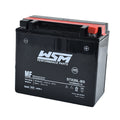
| Fully charge the battery on a smart charger, then load-test it | A weak or sulfated AGM reads ~12V but collapses under load. It will mimic a charging fault and it will cook a new regulator by making it work overtime. Rule the battery out before anything else. | ⚡ |
| Clean and tighten both battery terminals and the ground strap | Corroded or loose grounds cause phantom "not charging" and low-voltage readings. Costs nothing. | ⚡ |
| Check the main fuse in the electrical box (often a 30A near the MPEM) | A blown main fuse looks exactly like a dead charging system. Cheap and common - check it before you condemn a $77 part. | ⚡ |
| Inspect the connector between the stator (yellow wires) and the regulator | This is the big one. Over time the plug develops resistance, heats up, and discolors or melts. A bad connector here will kill a brand-new regulator too. Fix the connection before you replace the reg. | ⚠ |
⚡ = often a free or few-dollar fix. ⚠ = verify this before buying a part, or you'll replace the same thing twice.
The 5-minute diagnosis (learn this once, use it forever)
All you need is a multimeter on DC volts and a way to run the ski safely (in the water or on a hose with the correct flush procedure). You're going to watch battery voltage go from rest to running.
- Key off, engine off: measure across the battery posts. A healthy, fully charged battery reads about 12.6-12.8V. If it's under ~12.4V, charge it first - you can't diagnose charging on a low battery.
- Start it and rev to cruising RPM (~3,000-4,000). Idle barely charges on these skis - some even show a slight discharge at idle, which is normal. You must rev it.
- Read the voltage while revved. Compare to the table below.
| Voltage at ~3,000-4,000 RPM | What it means | What to do next |
|---|---|---|
| Climbs to ~13.5-14.5V | Charging system is working. Your problem is the battery or a drain, not charging. | Load-test the battery; hunt for a parasitic drain (clock/DESS draw over weeks). |
| Stays at battery voltage (~12.6V) or drops when revved | Not charging. The stator, regulator/rectifier, connector, or fuse isn't delivering. | Check fuse and connector first, then test the regulator, then the stator. |
| Over ~15V and climbing | Overcharging - the regulator has failed and is dumping raw voltage (and often AC) into the system. This boils the battery and can fry the MPEM/CDI. | Stop running it. Replace the regulator/rectifier. Do not ignore a "12V high" alert. |
Root cause over symptom - why regulators die
A regulator/rectifier rarely dies of old age by itself. It usually gets killed by something you can fix:
- A bad stator-to-regulator connector. Resistance in that plug makes heat, heat cooks the regulator. Replace the reg without fixing the connector and the new one dies too. Repin/solder the connector, or in stubborn cases hardwire it.
- A weak or wrong battery. A tired battery makes the regulator run wide open constantly. Always start with a known-good, properly sized AGM.
- Overcharge feeding the brain. On 4-TEC skis, a failing regulator can pass AC voltage into the DC system. The MPEM hates that - the engine may run fine at low RPM and then cut out or "give up" at higher RPM. If you chase a high-RPM stumble and the charging voltage is wrong, fix the charging first.
Bottom line: fix the cause (connection, battery) or you'll be back here in a month.
Skip to your engine type
4-TEC (2002+): the regulator/rectifier is almost always the culprit
On the 1503 and 1630 4-TEC engines, when the charging system quits it's the regulator/rectifier the overwhelming majority of the time. The stator on these is robust and rarely fails unless the ski was run dry or badly overheated.
- "12V low" while running = it's not keeping up. (A "12V low" only at rest can just be a tired battery - worry when you see it with the engine running.)
- "12V high" = overcharging regulator. Shut it down before it damages the battery or MPEM.
- Engine cuts out at higher RPM with wonky charging voltage = classic sign the regulator is leaking AC into the MPEM.
- The OEM regulator uses SCR-type shunting that sheds heat; the MOSFET-style replacements run noticeably cooler, which is why a lot of guys prefer them on the higher-output skis.
If your gauge is throwing codes alongside this, read them first - see our Sea-Doo fault code lookup. A charging problem often shows up as a low-voltage code or triggers a check engine light.
2-stroke (580-951, RFI, DI): separate stator and rectifier
Older 2-strokes have a stator (the yellow output wires from the magneto) feeding a separate rectifier/regulator. Test in this order:
- Confirm the stator is making power (AC test). Unplug the regulator. Set the meter to AC volts. Start the ski and measure across the stator's yellow output wires, one pair at a time. You should see AC voltage that climbs with RPM (roughly 20V+ and rising). If a pair reads near zero or the pairs are wildly unequal, a winding is bad.
- Confirm the regulator is converting it (DC test). Plug the regulator back in, meter on DC volts across the battery, rev it. If the stator made good AC but you don't see ~13.5-14V DC at the battery, the rectifier/regulator is burnt out.
How to test the stator with an ohmmeter (only if the reg checks out)
Stator failure is uncommon - don't jump here first. But if the regulator tests fine and you still have no charge, test the stator windings with the meter on ohms, stator unplugged:
- Between the yellow output wires (each pair): should read very low, roughly 0.1-1.1 ohms. Nearly a dead short is normal for a winding.
- From any yellow wire to ground/engine: should be open (OL / infinite). Any continuity to ground means the stator is grounded internally and has failed.
If either test is out of spec, the stator is done. If both are good, the stator is fine - go back to the connector and regulator.
Symptom → cause → fix at a glance
| Symptom | Most likely cause | Fix |
|---|---|---|
| Battery dead after sitting; won't come back from riding | Battery discharged/sulfated; charging only maintains | Smart-charge and load-test; replace battery if it fails |
| No charge; main fuse blown | Blown fuse (sometimes a symptom of the reg failing) | Replace fuse; if it blows again, test the regulator |
| No charge; connector at reg discolored/melted | High-resistance connection cooking itself | Repin/solder connector; then retest |
| Voltage flat at ~12.6V when revved | Regulator/rectifier failed (most common) | Replace regulator/rectifier for your model |
| Voltage over 15V; battery boiling; "12V high" | Regulator failed (overcharge mode) | Replace regulator ASAP - protects battery + MPEM |
| Engine cuts at high RPM, charging voltage wrong | Reg leaking AC into the MPEM (4-TEC) | Fix charging before chasing the stumble |
| Reg tests good, stator AC low or grounded | Stator coil failed (rare) | Replace stator coil for your model |
The parts that fix it (Sea-Doo, verified fitment)
Find your ski, grab the right part. These are WSM replacements for Sea-Doo - always confirm your exact year/model with the Check Fitment search on the product page before ordering.
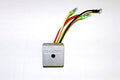
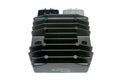
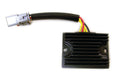
Voltage regulator / rectifier
| Your Sea-Doo | Part | Approx. price |
|---|---|---|
| 4-TEC 2008-2024 (GTI, GTX, RXP, RXT, Wake, GTR - 900 to 1630) | Voltage Regulator 004-221-01 | ~$77 |
| 800 / 951 DI & RFI 1998-2006 (GTX DI, RX DI, GSX RFI, GTX RFI) | Voltage Regulator 004-224 | ~$137 |
| 720 1997-2005 (GTI, GS, GTS, Challenger) | Voltage Regulator 004-223 | ~$44 |
| 720 / 800 1996-1999 (GSX, GTX, SPX) | Voltage Regulator 004-221 | ~$51 |
| 580-800 1990-2002 (SP, GTS, XP, SPI, HX) | Voltage Regulator 004-222 | ~$27 |
Early 4-TEC (2002-2007)? Fitment varies - use the Check Fitment search or browse the full PWC regulators & rectifiers and filter to your model.
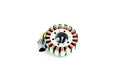
Stator coil / armature (only if the regulator tests good)
| Your Sea-Doo | Part | Approx. price |
|---|---|---|
| 1503 / 1630 4-TEC 2006-2017 (GTI, GTX, RXP, RXT, Wake, GTR) | Stator Coil 004-203 | ~$242 |
| 1503 4-TEC 2003-2005 (GTX 4-TEC, RXP, Sportster 4-TEC) | Stator Coil 004-203-01 | ~$128 |
| 1503 / 1630 4-TEC 2018-2026 (GTI, GTX, RXP-X, RXT-X, Fish Pro, Explorer) | Stator Coil 004-203-02 | ~$242 |
| 800-951 1995-2003 (GTX, RX, XP, SPX) | Stator Coil 004-200 | ~$186 |
| 951 DI 2000-2003 (GTX DI, RX DI, XP DI) | Stator Coil 004-201-01 | ~$75 |
| 951 DI 2004-2007 (Sportster LE DI, XP DI, 3D DI) | Stator Coil 004-201-02 | ~$100 |
| 800 RFI 1998-2005 (GTX RFI, GSX RFI, GTI RFI) | Stator Coil 004-201 | ~$91 |
| 580-720 1995-2005 (GTI, GTS, SP, HX, Speedster) | Stator Coil 004-202 | ~$269 |
Not sure which you need, or want to see everything for your model? Browse PWC stators, regulators & rectifiers, or the full PWC electrical section and filter to your year and model.
Related guides
- Sea-Doo fault codes - what the P-codes actually mean
- Sea-Doo cranks but won't start - a dead charging system and a no-start often share a root cause
- Check engine light - how to read fault codes and what to do next
The honest bottom line
Nine times out of ten, a Sea-Doo that "won't charge" is a bad battery, a bad connection, or a failed regulator - in that order. Charge and load-test the battery, clean your grounds, check the main fuse and the reg connector, then put a meter across the battery at 3,000-4,000 RPM. If it's flat, replace the regulator. Only chase the stator if the regulator tests good and the connector is clean. Fix the cause, not just the symptom, and you won't be doing this again next season.