Sea-Doo Fault Codes: The Common 4-TEC P-Codes & How to Fix Them
Share
Your Sea-Doo throws a beep and a wrench, drops into limp-home mode, or flashes a warning — and you're stuck guessing. Here's the good news: your ski already knows what's wrong. On 4-TEC (4-stroke) Sea-Doos, the computer stores a fault code, and you can pull it right off the gauge in about 30 seconds. Below are the codes you'll actually run into, what each one means, and the exact part to fix it.
How to read the fault code off your Sea-Doo gauge
You don't need a dealer or a scan tool to see the code — the digital gauge will show it to you:
- Press the MODE button to move through the gauge's information menu.
- Toggle to the Fault Codes screen.
- Press SET to display the stored code(s).
The exact button names and menu order vary a little by year and gauge, but the code always lives in the information-center menu. Write down what it shows — codes look like P0117, P0344, P0236 — then find it below.
Scope: this covers the common Rotax 900/1503 4-TEC codes. Newer iTC / iControl skis can label or display some codes a little differently, but the sensors behind them are the same parts. Older carbureted 2-strokes (587, 717, 787, 951) don't store P-codes this way.
Before you buy a part — read this first
A fault code points to a circuit, not always a broken part. Before you replace a sensor, check the cheap stuff: blown fuses, corroded or unplugged connectors, and chafed wiring. A few of these codes are frequently just a blown fuse — flagged with a ⚡. Swapping a $3 fuse beats buying a $57 sensor you never needed.
- ⚡ = often just a blown fuse. Check the fuse before buying anything.
- ⚠️ = verify the real cause first (fluid level, wiring, plugs) before replacing the part.
Supercharged skis: the intercooler-to-throttle-body trap (P1614)
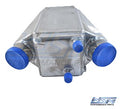
Here's the real failure: the intercooler develops an internal leak and sprays water into the intake. That water hits the electronic throttle body, corrodes the flap and actuator, and sets the code. Replace only the throttle body and the leaking intercooler will kill the new one too — and if you keep riding it, water intrusion can cook a head gasket down the road.
2-minute test: pull the intake hose off the throttle body, start the engine, run water through the flush port, and rev to ~4,000 RPM. If water sprays out of the intake, your intercooler is leaking — that's your root cause.
Fix it right: replace the intercooler (1503 4-TEC 08–17) · intercooler (1503/1630 16–26), and if the flap is already corroded, the throttle body (1503/1630 09–26). Doing one without checking the other is how people end up pulling this job apart twice.
Air, pressure & temperature sensor codes
| Code | What it means | Likely fix |
|---|---|---|
| P0106 / P0107 / P0108 | MAP (manifold air pressure) sensor out of range, shorted, or open | Air Temperature / Pressure (T-MAP) Sensor — check the connector first |
| P0111 / P0112 / P0113 | Intake manifold air-temp sensor faulty, shorted, or open | |
| P0116 / P0117 / P0118 | Engine (coolant) temp sensor faulty, shorted, or open | Engine Temperature Sensor (98–26) · Temp Sensor (1503 260HP 14–17) |
Throttle position sensor (TPS) codes
| Code | What it means | Likely fix |
|---|---|---|
| P0122 / P0123 | TPS out of range — short to ground, 12V, or open ⚠️ | Throttle Position Sensor — first check for a loose sensor/bracket or an over-tight throttle cable, which throw the same code |
| P1102 / P1104 | TPS adaption failed or cancelled | Needs a TPS reset with BUDS/CanDoo after ECM work — not a part |
Knock sensor code
| Code | What it means | Likely fix |
|---|---|---|
| P0236 | Knock sensor out of range ⚠️ | Knock Sensor — first confirm you're running the correct resistor spark plugs and proper wiring; the wrong plugs set this code with a good sensor |
Crankshaft & camshaft position sensor codes
| Code | What it means | Likely fix |
|---|---|---|
| P0336 / P0337 / P0339 | Crank position sensor — wrong RPM, no signal, or not plausible with cam ⚠️ | Crankshaft Position Sensor — on P0339, rule out a stretched timing chain before condemning the sensor |
| P0344 | Cam phase sensor signal missing ⚡ | Camshaft Position Sensor — if you also see P1200, it's a burnt TOPS 10A fuse, check that first |
Ignition coil & misfire codes
| Code | What it means | Likely fix |
|---|---|---|
| P0351 / P0352 / P0353 | Ignition coil #1 / #2 / #3 open or shorted ⚡ | Ignition Coil (1503 4-TEC) · fresh spark plugs — paired codes like P0351 + P0261 usually mean a burnt coil/injection 10A fuse |
Fuel injector & fuel pump codes
| Code | What it means | Likely fix |
|---|---|---|
| P0261–P0268 | #1, #2, or #3 injector short/open or shorted to 12V ⚡ | Fuel Injector (155–510HP 09–17) · Fuel Injector (130–310HP 02–11) — paired codes often point to a blown injection fuse |
| P0231 | Burnt starter / fuel pump 10A fuse ⚡ | Replace the 10A fuse |
| P01231 / P0232 | Fuel pump shorted or open circuit ⚡ | Fuel Pump (900/1503/1630 08–26) · Fuel Pump (1503 03–12) — check the 10A fuse first |
Oil pressure, charging & key codes
| Code | What it means | Likely fix |
|---|---|---|
| P0520 | Oil pressure switch faulty ⚠️ | Oil Pressure Sensor (1503 06–25) · Oil Pressure Switch (02–05) — confirm actual oil level first |
| P0536 | Battery voltage too high (over-charging) | Voltage Regulator / Rectifier — for P0562 also load-test/replace the battery and check ground connections |
| P0562 | Battery voltage too low ⚠️ | |
| P0513 | Incorrect DESS key | Use a DESS key programmed to your ski; reprogram if swapped |
Get the exact part for your code
Once you've got your code, grab the matching sensor, coil, injector, or pump from the tables above — or browse the full range. We ship Sea-Doo 4-TEC parts nationwide.
Related guides
Covers Rotax 900/1503 4-TEC engines. A fault code identifies a circuit, not a guaranteed failed part — always confirm with a visual inspection or a BUDS/CanDoo scan before replacing expensive components.