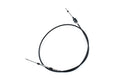
Jet Ski Steering Stiff, Reverse Stuck, or Throttle Sticking? It's Almost Always the Cables
Share
You go to launch, turn the bars, and something feels off. The steering is stiff and notchy. Or you reach for the reverse lever and it won't budge. Or the throttle feels gritty and is slow to snap back. Different symptoms, same root cause more often than not: a corroded control cable.
Jet ski steering, reverse, and throttle cables are consumable parts. They live in a wet, salty environment, they're full of grease that dries out over time, and the inner wire runs inside a tight housing that traps moisture. Sooner or later that wire starts to bind, rust, or seize. The good news is these are some of the easiest failures to diagnose — and once you know which cable is bad, replacing it is a straightforward job.
Here's how to tell steering, reverse, and throttle problems apart, how to confirm the cable is actually the culprit, and how to get the right replacement the first time.
First, understand what a control cable does — and why it fails
Every one of these systems works the same basic way: a lever or bar at the helm pulls a thin steel inner wire that slides inside a protective outer housing, and that wire moves something at the other end — the steering nozzle, the reverse gate, or the throttle body. When the cable is healthy, the inner wire glides freely and the control feels light and precise.
Cables fail for a handful of predictable reasons:
- Saltwater intrusion. Salt gets past the seals, sits against the inner wire, and rusts it to the housing. Saltwater skis eat cables far faster than freshwater ones.
- Dried-out grease. The factory grease inside the housing breaks down with age and heat, leaving the wire to drag on bare metal.
- Age and UV. The outer housing gets brittle and cracks, letting even more water in.
- Kinks and tight routing. A cable that got bent during a prior repair will bind at the kink and wear through early.
- No flushing. Skis that never get flushed after saltwater riding corrode from the inside out.
The pattern to remember: stiff, notchy, or seized controls are a corrosion problem, and corrosion problems don't get better. They get worse until the cable fails completely — sometimes on the water, which is exactly where you don't want it.
Symptom 1: Steering is stiff, tight, or won't return to center
This is the number-one cable complaint. On a PWC the handlebars connect through a steering cable to the jet nozzle at the back of the pump. When that cable corrodes, you'll feel it as:
- Heavy, stiff steering that takes real effort to turn
- A notchy or "catchy" feel instead of smooth movement
- Bars that don't self-center after a turn
- Steering that's noticeably harder in one direction than the other
How to confirm it's the cable: Disconnect the steering cable at the nozzle end (the ball joint at the back of the pump). Now move the inner wire by hand. If it still slides stiffly with nothing attached, the cable itself is corroded and needs to be replaced. If the wire moves freely once it's disconnected but the nozzle is stiff, your problem is the nozzle pivot or steering ball joints, not the cable.
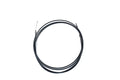
A stiff steering cable is not something to ride around. Precise steering is how you avoid docks, swimmers, and other boats. Once the inner wire is binding, replace the cable — don't chase it with grease. Browse PWC steering cables by your year, make, and model, then follow our step-by-step guide to replacing a jet ski steering cable.
Symptom 2: The reverse lever is frozen or won't move
A reverse lever that's stuck solid is a classic seized-cable symptom. On mechanical-reverse skis, the reverse lever pulls a reverse (or shift) cable that swings the reverse gate — the bucket — down over the jet stream. When that cable corrodes and rusts to its housing, the lever locks up and won't move at all, or moves part way and jams.
- Lever feels frozen, seized, or takes both hands to move
- Reverse gate doesn't drop, or drops part way and sticks
- Lever moves but the bucket doesn't follow
How to confirm it's the cable: Disconnect the reverse cable at the gate. Try the lever. If the lever is still stuck, the cable is seized — replace it. If the lever now moves freely but the gate is stiff, the gate pivot is corroded and needs cleaning or new hardware.
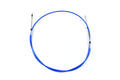
Important fitment note: This applies to skis with a mechanical reverse. Newer Sea-Doo models with iBR (Intelligent Brake & Reverse), roughly 2009-and-up 4-TEC craft, use an electronic reverse actuator and have no reverse cable at all. If your ski has iBR and reverse isn't working, that's an electronic or actuator issue, not a cable. For everything with a manual reverse lever, shop PWC reverse & shift cables by model — and for a full reverse walkthrough, see Jet Ski Reverse Not Working.
Symptom 3: The throttle is sticky or won't snap back
This is the one to take most seriously. The throttle cable connects the finger throttle at the bars to the throttle body (on four-strokes) or the carburetor (on two-strokes). When it corrodes you'll get:
- A gritty, stiff throttle pull
- A throttle that's slow to return, or doesn't snap fully closed
- Idle that hangs high after you let off
Why this matters: A throttle that won't return to closed can leave your ski under power after you release it. That's how people run into docks and each other. If your throttle feels anything but crisp and instant on the return, stop riding and fix it.
How to confirm it's the cable: Disconnect the throttle cable at the throttle body or carb and work the inner wire by hand. Stiff or gritty with nothing attached means the cable is corroded — replace it. Free-moving cable but a sticky throttle body means the linkage or return spring at the engine end needs attention.
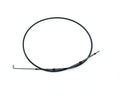
Fitment note: Like reverse, throttle cables live on carbureted two-strokes and older EFI four-strokes. Many modern 4-TEC Sea-Doos use ITC drive-by-wire (electronic throttle) and have no throttle cable. If you have a cable, get the right one from our PWC throttle cables collection.
Grease it or replace it? A simple rule
People always ask whether they can just lube a stiff cable and keep riding. Here's the honest answer:
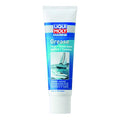
- Caught very early — slightly stiff, no rust — you can sometimes revive a cable by working marine grease into the housing with a cable luber. Worth a try on a steering cable that's just a little dry.
- Rusted, frayed, notchy, or seized — replace it. Grease will not un-rust a corroded inner wire, and a control cable that fails on the water is a safety problem, not an inconvenience. This is especially true for throttle and steering cables.
Cables are cheap relative to what they control. When there's any doubt, replace — and it's smart to replace a matching set (steering, reverse, throttle) at the same time if the ski is older and one has already gone, because the others are living in the same salty environment and are usually not far behind.
Get the right cable the first time: match by year, make, and model
This is where a lot of people waste time and money. Cables are length- and fitting-specific. A steering cable for a 2007 Sea-Doo GTI will not fit a 2015 GTI. Yamaha, Kawasaki, and Sea-Doo all use different cable ends, lengths, and routing, and they change them between model years.
Don't order by eye or by "close enough." Match by your exact year, make, and model, and check the cable end style before you buy. That one habit eliminates almost every wrong-part return.
We stock steering, reverse, and throttle cables for Sea-Doo, Yamaha WaveRunner, and Kawasaki, filterable by your exact craft. Start here: shop all PWC cables, then narrow to steering, reverse, or throttle.
Quick diagnosis recap
- Stiff, notchy, or non-centering steering → steering cable. Confirm by disconnecting at the nozzle.
- Frozen or jammed reverse lever → reverse/shift cable (mechanical-reverse skis only; iBR is electronic).
- Sticky throttle or slow return → throttle cable (cable-throttle skis only; drive-by-wire has none). Treat as a safety issue.
- Control still stiff with the cable disconnected → the cable is bad. Replace it, matched to your year/make/model.
Catch a corroded cable early and it's a cheap part and an afternoon in the driveway. Ignore it and it becomes a seized control on the water. Diagnose the symptom, confirm the cable, and order the correct part for your exact ski — you'll be back on the water with steering, reverse, and throttle that feel like new.